Posts

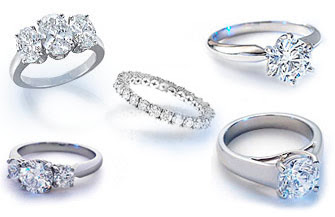
Diamond Wedding Rings

Image
Diamond rings are always precious, a symbol of love and affection.

Setting Style (Craftsmanship)

There are many different diamond ring setting styles, and there is an infinite number of individual embellishments that can create the diamond ring’s style. The more time the jeweler needs to craft the setting, the higher the labor-related portion of the cost should be. A ring that requires unusual skill to craft or will take longer due to intricacy will naturally cost more than a diamond ring set in a standard setting.

Market Conditions

The world has many diamond mines. The world also has laboratories creating gem-quality diamonds. Realistically, supply is very high, and the addition of a few more laboratories or a new diamond mine should not impact the diamond ring prices. Additionally few people realize that the diamond market is not a ‘perfect market’ like that for stocks and bonds—it is a near monopoly that for more than a century has been controlled by the Oppenheimer family through their majority stake in the DeBeers holding company. Today the Oppenheimer family shares majority ownership with a global mining conglomerate Anglo American. Founded in 1888, DeBeers managed to gain a monopolistic position in the world’s rough diamond markets in the 1930’s by tightly controlling the supply of rough stones to the diamond market. They achieved this through ownership of or strict partnerships with all the largest diamond mines in Africa (primarily Botswana, Africa’s largest diamond producer) and, at some point, with Russ...

Conception

Diamonds have been dug out of the ground for centuries. Diamonds have been grown in laboratories for industrial purposes for mere decades. As laboratories perfected their techniques, they were able to produce gem-quality stones, diamonds impossible to differentiate from natural diamonds without sophisticated testing. Most jewelers can’t tell the difference—until they look for the brand name inscribed on the diamond girdle or read a brand name on associated packaging. There are a few indicators, though. Natural diamonds are more likely to have internal flaws. Fancy color diamonds—very rare in nature—are more likely to have been cultured in laboratories. Nonetheless, both natural and man-made diamonds can be certified by major gemological laboratories and are held to identical standards. There is, however, one large differentiating factor: price. Natural diamonds command a price premium over “man-made,” “laboratory grown,” “cultured” diamonds. So, if you have your heart set on a diamon...

Transparency (Cloudiness)

Colorless, transparent diamonds are valued more highly than white, milky, or cloudy diamonds. However, transparency is not specifically graded during certification. To test for transparency, view the diamond from several directions, including the sides, to judge whether you can see through the diamond like you would through a clear glass of water. Transparency is often confused with clarity. Clarity describes inclusions and surface blemishes; a white cloud is one type of inclusion that can impact clarity grade. However, some diamonds are white or cloudy throughout. These non-transparent diamonds will not have the same sparkle as transparent diamonds; at one time they were considered industrial grade, not worthy of cutting into gemstones. Transparency is sometimes confused with color. When a dealer requests certification for a cloudy diamond, he can ask that clarity grade not be included. The resulting evaluation may determine the diamond is “fancy white” in color. Beauty is in the ...

Certification

Diamonds can be sold with or without certificates authenticating their 4Cs. Diamonds without certificates should cost less than their certified counterparts. For example, one popular jewelry retailer sells a round, one-carat solitaire diamond in a 14-karat white gold ring for $3,100. The same jeweler sells a ring with the same description, plus the word “certified” for $4,800. Both diamonds are I-color, I1-clarity, one-carat, round. So, they may be exactly the same diamonds, except one is certified. There are many sources of certifications, from world-known gemological institutes to jewelry store in-house gemologists. Diamonds certified by well-known laboratories such as GIA and AGS carry a premium, so they will naturally cost a little more than diamonds certified elsewhere. If you are certain the diamond’s qualities are being accurately represented, you can always send the diamond for certification after its purchase, usually for much less than the price difference between certified...

Shape (Cut Design)

All diamond shapes are not created equally. Some require larger rough diamonds from the start. Others waste more rough diamond than their peers. And some require jewelers with higher levels of expertise. Round cuts, which remove more of the rough diamond than most other cuts, are more expensive to produce. By comparison, an emerald cut diamond with similar grades in carat weight, color, clarity, and cut, may cost 30% less than its round cut counterpart. However, since over 75% of the diamonds sold are round cuts, if the diamond ring may ever need to be resold, it should be easier to resell if the stone is a round cut.

What is a Blood Diamond?

A “blood diamond” (also known as conflict diamond, war diamond, dirty diamond, hot diamond, or converted diamond) is mined or produced in unethical conditions, including in war zones to finance insurgencies. In 2003, the UN-backed Kimberley Process began requiring participating countries to certify that their exported diamonds were conflict-free. According to the World Diamond Council, this program has been very successful, with 99% of the world’s diamond supply certified as conflict-free. Some other estimates are not as optimistic, but the Kimberly Process does seem to work—the amount of blood diamonds in the market is estimated to have dropped from 15% before the Kimberly Process was introduced to less than 5% today. Some retailers also offer “conflict neutral” diamonds . The retailer or the consumer makes a donation to a relevant charity, with the expectation that the good works promoted by that donation help balance against the negative works in the diamond industry. An alternat...

Where Do Diamonds Go?

Diamonds are most often associated with jewelry, but their strength is highly sought in a variety of industrial applications: to cut, polish, and grind hard surfaces; to manipulate concrete, metal, ceramic, computer chips, eyeglasses, stones, and other gems; and as parts of surgical blades, heat spreaders, and specialty windows. Even though 80% of the natural diamonds mined each year go toward industrial purposes, four times as many diamonds are synthetically created to also go toward industrial use. Approximately 25 million carats of natural diamonds go toward jewelry each year, another 80 million carats of natural diamonds go toward industrial use, and an additional 570 million carats of lab-manufactured synthetic diamonds are created for industrial purposes. This does not mean synthetic diamonds should not be considered for jewelry. Prices are much lower than natural diamonds, and the quality can be worse or better than a natural diamond.
Where do diamonds come from?

How are diamonds formed? What is the geographic origin of my diamond? What is a blood diamond? How do I know whether my diamond is conflict-free? How effective is the Kimberly Process? Answers to these questions are covered in this article.

Laboratories

“Manmade diamonds” are actually more prevalent than natural diamonds. Since 1950s, laboratories have manufactured diamonds, either by forcing carbon atoms to juncture under extreme heat and pressure or by reducing methane gas. Depending on the particular company’s formulation, the process can take days to weeks. Though the process is sped up, diamond formation is still a sensitive process where conditions fluctuate, yielding diamonds just as flawed and unique as those found in nature.

Loose Diamonds Buying Guide

What is important to you as a diamond buyer: shape, size, quality, store’s brand name, ring setting design? Learning about these attributes will help you decide exactly what you want in a diamond. Once you narrowed it down, the DiamondPriceGuru.com search engine will help you do the rest.

Hardness

Diamond is a perfect "10" , defining the top of the hardness scale, and by absolute measures four times harder than sapphire (which is #9 on that scale).

Tensile Strength:

Diamond has the highest tensile strength of any material, at 2.8 gigapascals. However, that does not quite translate into the strongest rope or cable, as diamond has cleavage planes which support crack propagation. The strongest ropes can likely be made from another material, carbon nanotubes, as they should not suffer from the effects of cracks and break. Still, if a long, thin, perfect crystal of diamond could be manufactured, it would offer the highest possible pulling strength (in a straight line - don't try to tie it in a knot!)

What Is a Diamond

Diamond is the ultimate gemstone, having few weaknesses and many strengths. It is well known that Diamond is the hardest substance found in nature, but few people realize that Diamond is four times harder than the next hardest natural mineral, corundum (sapphire and ruby). But even as hard as it is, it is not impervious. Diamond has four directions of cleavage, meaning that if it receives a sharp blow in one of these directions it will cleave, or split. A skilled diamond setter and/or jeweler will prevent any of these directions from being in a position to be struck while mounted in a jewelry piece.

How Expensive !

Quality for quality, fancy pink diamonds are more expensive than ordinary near-colourless ones. We have seen astronomical prices quoted for pink diamonds, but we manage to source small numbers at reasonable prices. Most pink diamonds, even enhanced ones, are more expensive than white ones of similar quality. Natural pinks are more valuable than enhanced, deep intense colours are generally more expensive than pale pinks. There are obviously many different varieties of pink, the "nicest" pinks are the most desirable and most expensive.

Pendants & Ear-Rings

We have also made a few pendants, and are about to produce our first pair of pink diamond ear-rings. Because of the variation in colours, and the small numbers of pink diamonds we get to see, it is not easy to find matching pairs of pink diamonds for ear-rings. Watch this space. Actually look out for new links near the top left of this page.

Diamond Polishing

Argyle Diamonds carefully selects the best quality diamonds for polishing within Australia or by overseas cutting centres.

Overseas Production

Argyle Diamonds also sends a proportion of its rough diamonds, especially those in smaller sizes, overseas for polishing.

Argyle Diamonds

Argyle Diamonds fall into three main categories: pink, champagne, and white diamonds. The 4C's guide to quality and value applies to coloured diamonds just as it does to white diamonds. However, coloured diamonds are graded for their intensity of colour, not lack of it. Argyle diamonds have two very unique and outstanding features: they are harder than other diamonds and may fluoresce blue under ultra-violet light.